
How to Find a Job Abroad: 5 Steps for EU Citizens
24. April 2026.
If you are an EU citizen and are considering working abroad, we would certainly like to suggest that you look into EURES’ mobility program, designed specifically to help job seekers find employment and relocate to any country within the EU, Iceland, and Norway.
Through this program, you can obtain consultative and financial support for relocation, language learning, traveling for your interview, and other key steps in employment. Check out the details here.
But, regardless of whether or not you’re applying to the mobility program, you’ll still need to find a job abroad. Here’s how to do it in five easy steps.

Find a Job Abroad in 5 Steps
The process of finding a job and getting hired in one of the EU member states is significantly easier for EU/EEA citizens since they have the right to work and live in these countries without special permits.
The Swedish Migration Agency clearly states that all you’d need in this case is a valid ID or a valid passport – which means you can start working as soon as you relocate.
Still, we recommend checking with your employer whether you truly meet all the requirements. For example, certain professions, such as doctors and nurses, also need their qualifications to be officially recognized by the relevant authorities in the EU member state to which a person relocates.
If you’re coming from outside the EU, you can still get a job in the EU member states, but the process will likely take extra steps, such as obtaining a residence and work permit.
You should definitely keep this basic information in mind, but now let’s take a closer look at what the job search process would look like using an example: finding a job in Sweden.
1. Learning Swedish
The first step is learning Swedish, since it’s practically impossible to find a job in this country without knowing the official language. There are indeed some exceptions – like in the IT industry or international companies where work is often performed in English or another language. But, for most jobs, knowing Swedish is either a requirement or a significant advantage.
The good news is that you can get financial support for a Swedish language course, i.e., a refund of up to 2.200 euros, through the EURES’ mobility program.
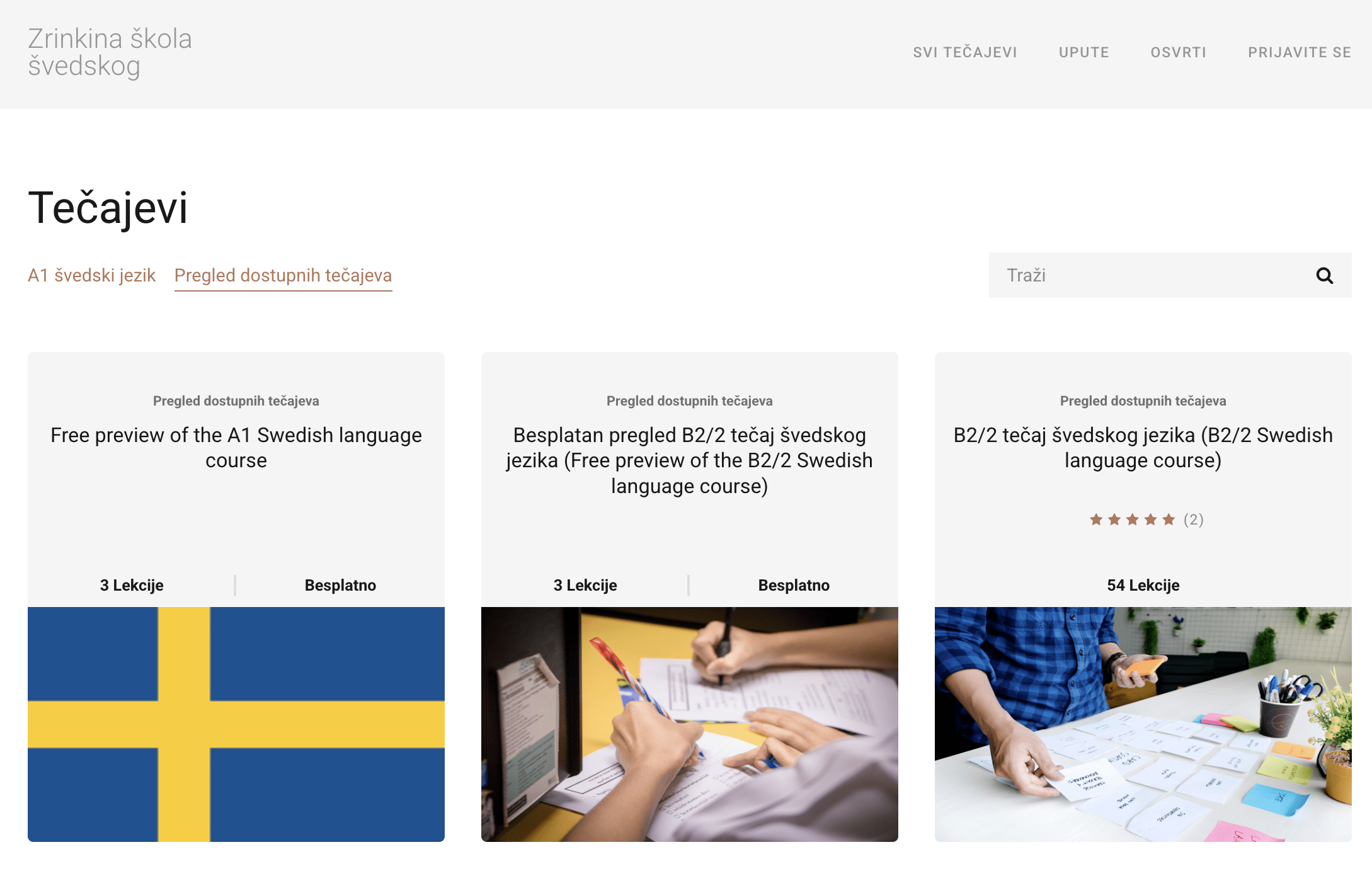
Language courses in Zrinka’s Swedish School meet all the requirements of the EURES program. There are courses available for levels from A1 to C1, and they are held entirely online. We combine materials you can review at your own pace with classes held in real-time in small groups.
From our experience, this gives you the best of both worlds. You can adjust learning Swedish to your schedule, while still having the opportunity to practice the language live with the lecturer and other participants.
After you successfully complete a course, you get a certificate. As we’ll see below, this can give you an advantage over other candidates.
Regardless of which course or method of study you choose, one thing is for sure: knowing Swedish will open many doors for you in the labor market, and we can consider it the first requirement for employment.
2. Searching for Jobs in Sweden
The next step is to actually start looking for jobs. Although this can be challenging, today, we have numerous online platforms and tools that can facilitate the process. With that, we’ll highlight four possible ways of finding a job in Sweden:
- through traditional search ads,
- with the help of expert consultants or private employment agencies,
- by contacting the companies directly, and
- via referrals.
Let’s start with the most usual route. Most candidates typically find job listings on online platforms such as:
- EURES
- Swedish Public Employment Service (Arbetsförmedlingen)
- Other platforms employers use to advertise jobs, such as Indeed or LinkedIn
To accelerate the process and dispel any doubts, you can work with consultants who know the job market and have the right contacts. For example, EURES has its own advisors, and Arbetsförmedlingen or your own country’s public employment service could be of help, too.
If you are looking for a job in the Swedish healthcare sector and would like assistance from expert consultants, Incor is at your service. We support you every step of the way, from obtaining a license to submitting applications on your behalf. Learn more about our services specialized inspecialized in consulting services and representation services.
The second option is to work with private employment agencies, such as Allen Recruitment and Airswift. One tip: always check whether the agency is registered and operates transparently. In the EU, agencies should not charge job seekers fees for basic mediation services.
A third option is to contact companies directly:
- Find the official website of the company you’d like to work for
- Go to the “Careers,” “Job openings,” or a similar page
- Look for contacts in HR or the relevant department (or simply fill out an application form, if available)
- Send a personalized application along with your CV
The final option is to try to find a job in Sweden through referrals. If you know someone who already works there, ask them to recommend you to their employer, or to check for open positions elsewhere and provide you with a strong reference.
3. Prepare Your CV, Cover Letter, and References
When applying for a job in Sweden, it is important to submit complete and accurate documentation—specifically the documents requested by the employer, i.e. your full portfolio. This usually includes:
- CV (résumé) – We recommend tailoring your CV to the standards of the country where you’re applying for a job.
- Cover letter – A one-page document that accompanies your CV and explains why you are applying, what motivates you, and why you are the right candidate. This is the very document that should capture the attention of HR professionals, prompting them to open your CV and invite you for an interview.
- Presentation – A presentation of yourself as a job seeker, adapted to the country’s standards.
- References – Recommendations from former employers, supervisors, or colleagues that speak to your professional skills, work habits, and character. In Sweden, employers often contact these references to verify their authenticity.
- Documents that prove your professional qualifications.
A portfolio gives the employer a comprehensive impression of your work experience, motivation, and professional reliability. Without a well-prepared portfolio, your application will often not be accepted, so prepare it carefully and conscientiously.
Within the portfolio, you will often also need another document we’ve already mentioned: a certificate proving your proficiency in the language of the country where you’re applying for a job.
As noted, candidates who include a certificate often have an advantage in the hiring process. Keep this in mind when choosing a course – avoid those that do not issue certificates upon completion.
You can prepare the portfolio yourself, or seek professional support from consulting firms like Incor, which offer portfolio preparation services tailored to the standards of the country you’ve chosen as part of their representation services.
4. Interview Preparation

It’s good to know that the interview may be conducted remotely (online) or in person. In the case of an in-person interview, pay attention to the dress code, which is often business casual, unless stated otherwise. Also, keep in mind that EURES may cover your travel expenses for the interview.
5. Finding Accommodation
Finding accommodation in Sweden can be challenging, as demand is high and the supply of housing, especially rentals, is limited.
That’s why, even if you don’t want to commit right away by booking an apartment or house, it’s a good idea to start your housing search in parallel with your job search. This comes with several benefits:
- Exploring the market early will give you a more realistic picture of prices, locations, and rental conditions.
- Communication with landlords can take time, and you may be asked to provide references or proof of employment. Gathering this documentation can also take time.
- Preparing in advance will make your move easier once you secure a job.
Starting early will also give you time to think about where you want to live. Which neighborhood do you prefer? Is proximity to schools or kindergartens important to you? What about a shopping center or a hospital? If you give yourself enough time, you’ll be able to find a home that meets all your criteria. Incor’s expert consulting services can support you at this stage as well.
Steps After Getting a Job in Sweden
If you’ve successfully secured a job in Sweden, it’s time to be patient, as you’ll need to go through several standard administrative steps before and after your arrival.
The first step, before departure, is to check with your employer whether you need official recognition of your qualifications. For certain professions, such as healthcare workers, teachers, and engineers, this may be mandatory. If it applies to you, you should start the process as soon as possible, as it requires a considerable amount of documentation.
After arriving in Sweden, there are a few additional steps you’ll need to take:
Non-EU citizens: your first step is to arrange your right of residence. To do this, contact the Swedish Migration Agency (Migrationsverket).
EU citizens: if you are a citizen of an EU/EEA country, you have the right to work, study, or live in Sweden without a residence permit, provided that you are employed, self-employed, a student, or have sufficient means to support yourself. This is known as the right of residence. If you already meet these conditions, you do not need to contact the Swedish Migration Agency.

However, if you plan to live in Sweden for a year or longer, you are required to register in the Swedish Population Register, i.e., register as a resident of Sweden. The information required for registration includes your full name, address, date of birth, and marital status.
You also need to contact the Tax Agency (Skatteverket). Your employer is obligated to register you as an employee, but you are responsible for your own registration and for obtaining the necessary identification numbers and status.
After registering with the Tax Agency, you will receive a “personnummer,” a personal identity number, which you will need in everyday life – for example, to receive a salary, obtain an ID card, and more. The good news is that you do not need to worry about taxes, as they will be automatically deducted from your salary if you are employed by a Swedish employer.
Finally, you will need to open a bank account. This will be necessary for receiving your salary, paying rent and utility bills, and managing daily life. We recommend scheduling an appointment with the bank in advance and checking exactly which documents are required.
Start learning Swedish online with a flexible schedule
Whether you plan to take advantage of the EURES mobility programme or find a job in Sweden independently, the first step is learning the Swedish language. You can get started today at Zrinka’s Swedish School.
Simply choose a course at the appropriate level and sign up using your email address. The instructor will get back to you as soon as possible to arrange a free introductory consultation.